Here’s a glimpse in the life of a family touched by ZARD. If you would like your story to be featured too, we will be happy to share it.
Please send it to connect@zc4h2foundation.org
By Thomas Simcoe
-To love another person is to see the face of God. (Victor Hugo)
Introduction
If you are reading this having recently learned that your child or a child in your life is touched by ZARD, I’m sure you are feeling overwhelmed and perhaps filled with fear for what it all means, as we once were. Hopefully you will find some of what I share below helpful, perhaps even reassuring. I certainly would have.
A bit of our story for background: Our oldest daughter Naomi was born in 2006, before there was a map of the ZARD world. In those days, ZARD didn’t exist as a diagnosis. Medically, at the edge of the known world, the only diagnosis given to us was that Naomi had arthrogryposis multiplex congenita (AMC). As you probably already know, AMC is a very rare condition with hundreds of different causes. The medical map beyond AMC presented to us when Naomi was born was simply marked “Here be dragons.” We pursued every available avenue for a diagnosis, going through all of the available diagnostic tools of the time and visiting specialists throughout the Northeast, and even travelling to the West Coast. We learned, in a word, nothing. Every test essentially came back negative or came up empty. So for many years we didn’t learn anything about Naomi’s condition that we couldn’t see with our own eyes (or with medical imaging technology). The only way to learn about Naomi’s developmental arc was by living it. So the answers came in the form of a long slow reveal, by living the life allotted to us.
Now, as Naomi fast approaches her 20th birthday, I hope that I can share with you what I learned over these two decades, and what I would have wanted my 28-year-old self to know about her life to come. It has certainly been a challenging life, but one that I have loved and would not trade for any other.
One last preliminary note: although Naomi’s journey has been filled with medical consultations and interventions and therapies of all kinds and colors, I’m not going to spend time on that here. Others have already addressed the medical side of things better than I ever could. I’m sure you’ll do your best with all of that, as I believe we have. But also, my personal philosophy is that medical interventions and therapies are not ends in themselves but tools we deploy in service of other purposes attainable in all of our lives- ways to seek out grace, joy, meaning, fulfillment, and connection. For some, this includes faith and a connection to the divine.
So if I may share a bit of advice for you as a veteran ZARD parent (and as a reminder for myself), as you contemplate the implications of having a child with a medically complex, and perhaps fragile, childhood: Don’t forget to seek grace and joy as much as you seek any other thing for your family’s life. If you are like me, you will remember the times that you find such things as much as you’ll appreciate the results achieved by a therapy you fought for access to, or finding that device that might lead to that incremental increase in functionality or achievement.
What do I know now that I wish I had known on day one?
One of our biggest worries when Naomi was first born was what kind of family life was possible for us. Naomi’s disabilities arrived like a lightning strike out of a clear blue sky, totally flipping the future life we had imagined upside down. We were in our twenties when Naomi was born (she was our first child), and I was just one year into my legal career. Naomi’s mother (my wife), Jiyoon, was then studying toward a pharmacy degree. We imagined having many children- five was Jiyoon’s dream and I was up for that if she was. Immediately everything we imagined for ourselves was in doubt. Would we ever have more children? Was there any chance that they would be healthy? What was the risk that they wouldn’t be? What would happen to our careers if we needed to focus so much energy on Naomi’s needs? And we worried about even more fundamental things: Would our families be able to embrace and love Naomi like they would a “normal” child? How would strangers react to her? How much would she be able to understand about life and feel? Would she even be able to love us? To laugh? To make jokes? What about us as a couple? Our seemingly charmed future was gone. What was our future going to be, and who were we going to be in it?
At the time in late 2006, I kept thinking about the tsunami that had caused so much devastation in South Asia just two years earlier. Jiyoon and I had been on a honeymoon trip to Paris while the catastrophe unfolded. We were having the time of our lives walking around town all day, but following closely on the news when back in our hotel room. It seemed incomprehensible how our own lives could be full of light while so many were suffering on the other side of the world. And so it kept playing over in my mind in those early days while we were trying to understand Naomi’s condition. Sometimes the tsunami comes for millions of strangers 10,000 miles away, and sometimes the tsunami comes just for you, to your own front door. Perhaps you may feel this way as well.
Fast forward twenty years and I would say that to this point in our lives we have been very fortunate. We did have two more children, approximately four and eight years after Naomi, both of whom are healthy and thriving. Jiyoon became a stay-at-home mom for nearly two decades (more than a full-time job), although she has recently ventured back to work. Her years at home were at times deeply difficult and isolating for her, while also being rewarding and undoubtedly deeply beneficial for the children. She had to learn to navigate our byzantine health insurance and government benefits system using English as a second language. She was phenomenally successful at doing so. I’ve never heard of anyone who was able to consistently achieve the kind of victories she has, and my career has turned out fine. Most importantly, Naomi has been loved every bit as much as a “normal” child by everyone in the family, on both sides, and by the world at large. If I had only known that from the start as a new father, it would have brought me great relief from many of my worst fears. That and knowing that I would get to have a relationship with such a loving, humorous, compassionate, passionate, and inspiring girl and young woman, along with her siblings (both remarkable and special in their own right) to fill my life.
Of course, having Naomi has at times isolated us from our peers (even the most welcoming and compassionate), and there are often times of grief that come and go, as you can imagine. This is real and something that can’t be sugarcoated. But life with Naomi has also shown us the greatest kindness and generosity that exists in family, friends, and strangers all over the world, which we never would have known without her.
Functionally, what does having ZARD mean for Naomi?
One thing that we’ve come to know is that ZARD can impact the abilities of those it touches in a wide spectrum of ways. I’m certainly not qualified to say where Naomi falls on that spectrum relative to others, but based on what I’ve seen and heard I think that physically Naomi is on the weaker/more comprehensively impacted end of the spectrum from a global muscular and skeletal perspective, while being perhaps less intellectually and emotionally affected than many. In case it is helpful, I’ll do the quick rundown of Naomi’s ZARD characteristics: AMC affecting all of her joints to some degree, global low muscle tone, cortical visual impairment, childhood dyspraxia of speech, epilepsy, Duane Syndrome, diffuse white matter abnormalities, and low lung capacity/restrictive lung disease. She takes Keppra for her epilepsy and birth control for convenience to manage the timing of her menstrual cycle. She takes various medications at times for respiratory issues. She needs assistance with toileting but only rarely has accidents. I’m sure I’m forgetting things, but those are the main ones. All of that said, she has been quite healthy for a long time. After we learned to carefully manage her weight and got her epilepsy under control, her health became very stable.
Nowadays Naomi is sick less frequently and usually more mildly than her younger siblings. I don’t think she has thrown up in a decade (knock on wood). From a gross motor perspective, she is able to drive a power wheelchair pretty well, which is very important for her independence. She didn’t start using it in the house until her late teens, but that was due to my concern about the safety of her younger siblings more than anything else. She drives very slowly, as her reaction time and vision are not good (she is legally blind so I’ve become adept at patching drywall holes in my spare time). It is also extremely useful that she can tilt herself backward and otherwise adjust her position using her chair’s elevation and tilt functions. Absolutely everything else in her daily life, from brushing her teeth to preparing and serving her food, to getting in and out of bed and personal hygiene, requires assistance. From a fine motor perspective, her abilities are also very limited due to muscle weakness and a complete inability to bend any of her fingers. That said, she can do many things that are important to her. She can feed herself from food that is within her grasp at the table, and she can do the thing that is as important as eating and walking in modern life: she is able to manipulate a smartphone or tablet quite well.
Communication and Oral Motor Skills
Communication is perhaps Naomi’s greatest strength. She is able to speak without any aid or assistance, which is likely the most important thing for her quality of life. For a very long time this seemed impossible—she was unable to speak in any meaningful way until she was about five. (I’ll never forget the morning she said her first complete sentence. It was early on a weekend morning in the spring when the whole family was still in bed, and I heard Naomi say from her room down the hall, haltingly, “Happy… birthday… to… me.” Never mind that it was not her birthday or anyone else’s!) It has been a very long and winding journey, but most people she meets today can understand her quite well. Not absolutely everyone can understand her, and not everything she says is intelligible to everyone (particularly when she is talking about her more obscure interests), but her abilities are well past the basic threshold needed to connect meaningfully with people who want to know her. Fortunately for her, she has endless patience for repeating herself. It is a superpower for someone with apraxia of speech. She will keep trying to make herself understood long after everyone else in the house wishes she would give up and move on to something else. She is persistent like that!
Relatedly, she was unable to swallow safely and thus eat orally for the first year plus of her life. There was a time when that seemed impossible, but in time she mastered it and developed a coordinated swallow. Now food is one of her greatest enjoyments in life. So if that is something you are struggling with today, please know that your child may also improve in this area given time. Naomi is also able to spell quite a bit, which allows her to text people and make phone calls. And her abilities allow her to research and explore her interests on the internet, which is a major factor in her quality of life (just like all of us). More on this below.
An Overview of Naomi’s Educational Journey
Naomi graduated from high school last year. Her educational experience has been varied. From around age four, she began attending a private preschool with early intervention support, and then attended kindergarten in a city public school. Unfortunately, while she was in kindergarten she developed epilepsy, which was at that time poorly controlled, and also became significantly overweight. As a result, Naomi got pneumonia multiple times and faced other life-threatening health concerns. To better manage her health we wound up having Naomi home instructed (i.e., a special education teacher and therapists came to our house), which we continued until late in middle school.
Eventually, we moved to a suburban school district that had many more resources for Naomi and we felt confident about her returning to a school setting full-time. Naomi has thrived in a school setting, enjoying wonderful relationships with teachers and other students. In high school Naomi was placed in a functional skills development program attended by high-functioning classmates with intellectual disabilities. Her teachers, aides, and therapists have been truly outstanding: thoughtful, caring, compassionate, and dedicated. Her classmates, too, have been one of the loveliest groups of young people imaginable.
As many with ZARD will know, Naomi’s physical needs would normally place her with a population of mostly nonverbal and extremely cognitively impaired children, but her social skills and intelligence make that kind of environment a bad fit. This program really helped her to bloom, giving her confidence to get out in the world and interact with new people. Her fellow classmates are a social group, and they enjoy each other’s friendship and company quite beautifully.
Of course, it is basically impossible to test the IQ of a person with ZARD. Naomi’s interests, thoughts, and capacities defy any attempt at categorization. I like to tell people that sometimes Naomi is putting together 2,000-piece Lego sets and sometimes she’s playing with Duplos, depending on the subject. She is passionately devoted to the writer Jeannette Winterson, for example, and has read and re-read certain of her works dozens of times. Take a moment to investigate Oranges Are Not the Only Fruit and Dark Side of the River. Her works are very profound and complex. (Note: if you do look into Jeannette Winterson’s work, I’ll warn you that, in our view, many of her writings would be extremely inappropriate for Naomi, so we edit them as we think best- peruse with caution). On the other hand, Naomi still likes watching Daniel Tiger’s Neighborhood on her mornings off from school and is incapable of doing first-grade math, despite 15 years of effort.
Now, at age 19, Naomi is enrolled in a community-based program provided by our school district, which she can remain in until she turns 22. In this program, she spends half of her day in instructional activity related to life skills and half of her day working in various jobs, mostly as a greeter, which she greatly enjoys. What will come next for Naomi is very hard to say. None of the programs close to us look like they will be a good fit, either because her cognitive abilities are too high or because her physical needs are too great. We’ll update this when we know more.
Connecting with Others
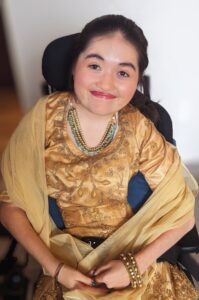
Naomi has an amazing ability to connect with people. She somehow always remembers the names of people’s pets and children, and always asks how they are doing. She loves making bracelets, and sometimes will build up a huge stockpile of them, wearing as many as 30 at a time. She does this with a plan that on some particular day she is going to give them all away, like on a trip to the dentist or when she goes to summer camp. When the day arrives, every single person she encounters will get a big smile and bracelet. People are wonderful about it. Occasionally we’ll run into someone who had been given a bracelet on one of these giveaway days months later and they will still be wearing it. You learn a lot about who might have a surprisingly sweet side to their personality that way.
Naomi is deeply empathetic about other people’s hardships. If she learns that someone is sick, she always remembers them and asks about how they are doing. If someone she knows has cancer, she will think of them daily. Her grandmother is a parish life director in a church, and Naomi calls her nightly- a regular vigil which includes inquiring about the well-being of everyone in the parish that she might have heard was struggling with something. Naomi has always had a special bond with the elderly and greatly enjoys spending time with older people. She likes to visit nursing homes, particularly if she can bring her dog, a Shih Tzu named Chai. For many years, Naomi had the most beautiful friendship with a retired Sister of St. Joseph, Sister Martha McCaffrey, who lived in a nearby convent. When Naomi was very sick early on in her life, somehow her name wound up on a prayer tree at the convent, and a sister named Sister Naomi decided to pray for her because of their common name. When Sister Naomi passed away, Sister Martha picked up the names of people that Sister Naomi had been praying for and added them to her own list. Sister Martha had assumed that Naomi was an elderly person because most of the other people being prayed for were, but when she came to learn that Naomi was a young girl, she reached out to Naomi’s grandmother through a mutual acquaintance. It was decided that Naomi and Sister Martha should meet for lunch one day at the convent, which turned into regular visits by Naomi and her siblings for many years.
Social Peer Group
Does Naomi have friends? Yes and no. In the sense that a new parent may initially envision, of friends who are peers her own age, with whom she engages in mutual self-directed play and other activities as they mature. She has had friends to a limited extent, at certain times in her life. When she was younger and her developmental differences from her peers were somewhat less meaningful, she enjoyed a few friendships with girls close to her age. These arose as part of larger family friendship connections or with neighbors. However, this kind of friendship dropped off as peers became increasingly independent of adult involvement. This didn’t necessarily need to be the case, and I don’t think it was a terrible thing. Many factors contributed to the particulars of Naomi’s experiences. One reason is that she was home-schooled for many years for health reasons, and so we did not foster friendships with other relatively high-functioning special needs peers in ways that we might otherwise have. Another reason is that she is the oldest child in our family. This contributed to her experience in different ways. Relevant to friendship, when all of our children were younger, Naomi was developmentally at a similar level to her younger siblings. There was a period when her next-youngest sibling was home-schooled, and so the children spent significant time playing together and engaging in other common activities as a group. She engaged in a lot of play in this context.
As Naomi reached middle school, a number of factors converged at once that resulted in fewer peer friendships. One was that we moved, which changed our social world a bit. Another was that her younger siblings were growing and their needs were changing too. As everyone knows, modern parenting is an extremely high-intensity activity. As Naomi’s younger siblings became older and engaged in multiple sports and other extracurricular activities, it became extremely challenging to keep them in step with their peers while also keeping up with Naomi’s needs, working, and running a household. For a period Naomi’s social experiences were more limited as a result. All of that said, she has had many people in her life that she enjoyed other kinds of friendship with. These came in a variety of forms, some of which I’ve noted above.
Naomi’s Interests and Passions
Naomi is a person with diverse interests and passions. One of her greatest loves is musical theater—she has seen dozens of shows, mostly national tours passing through our area. Naomi has also seen a couple of shows on Broadway. Her approach is immersive: often, when a show is coming to town, she will start watching bootleg recordings of musicals on YouTube (sometimes trying to watch every version available, regardless of the quality of the recording or performances) and will begin listening to the soundtrack in the weeks before a show comes to get herself deeply familiar with it. She was incredibly lucky to get the opportunity to have a very small part in her high school’s production of Legally Blonde last year, playing a Delta Nu. (This is a testament to the unbelievable kindness and caring of the musical theater director at our local high school, and the welcoming embrace of the students around her). One major struggle for her in pursuing this passion is that the sound of cheering crowds and clapping can be very overwhelming for her. We have learned that noise-cancelling headphones can reduce the roar to a manageable level, allowing her to return to her baseline whenever she gets overwhelmed. While it diminishes her ability to enjoy the show to some extent, the trade-off is worth it for her since the noise would otherwise be intolerable. Sneaking out before the grand finale is another useful hack, since that is typically the most overwhelming moment and also lets us skip some of the traffic.
Another of Naomi’s great pleasures in life is food. She loves trying out new foods from all around the world and will try the spiciest food imaginable. This past summer we took a trip to South Korea to visit family, where Naomi tried every dish possible, including eating live octopus. She doesn’t like yogurt and she doesn’t like bananas, but otherwise she’ll eat anything. Also, she loves eating dinner foods for breakfast. She will eat leftover chili for breakfast seven days a week. Naomi is by far the healthiest eater in the house.
Naomi also loves learning about different religions of the world. Our family comes from a Catholic faith tradition, and Naomi has participated in all phases of Catholic youth formation. She attended children’s liturgy and religious education classes, was an altar server, made her first communion, and was confirmed. But she has also sought to learn about other faiths as well. When she was only nine she tried fasting for Passover and Ramadan, and over the years has visited all kinds of places of worship, including participating in a one-hour meditation session.
Naomi’s Love for Reading and Writing
Naomi absolutely loves to read. She is legally blind, so she relies on audiobooks for the most part, but reading is an important part of her daily life. She tends to re-read the same books often, only adding new books into the rotation occasionally. I’ve already mentioned her favorite author Jeannette Winterson above. She also loves Like the Willow Tree by Lois Lowry and The Fences Between Us by Kirby Lawson from the American Girl Series. Another favorite is Where the Mountain Meets the Moon by Grace Lin. She loves Old Possum’s Book of Practical Cats by T.S. Eliot, and listens to it every other night when she goes to bed, alternating with a short children’s story, I Need My Monster by Amanda Noll. Naomi often emails authors she likes, and some of them even write back—most notably Lois Lowry. She loves to sit and read in the mornings on her days off after she has had her breakfast, preferably with her dog on her lap and her wheelchair tilted back. She also has a bit of functional reading skill. She can often read individual key words off of signs or on television, although she has trouble processing more than that. Does she write?
Naomi greatly enjoys writing. Writing by hand is extremely difficult and even her name is barely legible when she writes it. But she is able to write on an iPad and on her phone with a surprising degree of dexterity. She has spent hours writing short stories with plots that are similar to those of her favorite books. She likes texting people (a bit too much—most people she texts have to silence her before long). She is interested in keeping a diary—I say “interested” because she likes to watch YouTube videos about people reviewing their diaries, and sometimes spends time writing something for herself but always winds up deleting it and starting over. To be clear, her writing is not something an adult or even a precocious grade-schooler might write, but it is indeed writing and it is something she loves doing, which is really all that matters.
Long Distance Travel
Traveling with someone with Naomi’s level of physical needs is very difficult. There’s the ever-present threat of expected and unexpected wheelchair inaccessibility, in addition to the need to bring along a heavy toileting system and other additional equipment and baggage. As a result, we have travelled much less than we would have liked to due to the logistic challenges, which were particularly intimidating when Naomi’s younger siblings were young. Now that they are older and can be more independent (and are even able to be helpful, at least in theory) we have pushed the limits of what we previously thought possible. As I mentioned above, this culminated in our recent family trip to Korea. I would preface this by noting that Naomi also can be quite anxious about travelling, and indeed anything that involves a break from her normal routines. However, we have found that she overcomes this with practice and reassurance. When she was younger it was quite severe and sometimes it negatively impacted her (and by extension all of our) overall experience. For these reasons, we did not attempt a family trip to Korea (where Jiyoon grew up) until Naomi was nearly 19 years old. The younger kids were 14 and 11. We had taken trips at home a fair amount, mostly to places within a day’s driving distance in the Northeastern U.S. However, the trip to Korea involved a three-hour drive to JFK International Airport, a 14-hour flight from JFK to Seoul, hours of passing through customs, and a long ride into the city in a traffic jam—an unending series of challenges. However, Naomi tolerated it all with great patience and largely enjoyed it all. I could write 10,000 words on the logistics of it all. Travelling to Korea was a bit like going back in time to 2006, when we were unsure of how society would react to Naomi’s disabilities and how we would meet all of her unique needs. I’m happy to report that the Korean people were every bit as kind, generous, and warm toward Naomi as people are here at home, and our Korean relatives embraced Naomi with just as much love as our American relatives have. The handicap accessibility is actually much better in Korea. Most notably, there are handicap accessible bathrooms in all newer facilities there, and they are usually significantly larger than the bathrooms here. So major travel was yet another of those things that had for years seemed impossible but which became possible in time.
Other Adventures
Any account of Naomi’s life to date would be incomplete if it didn’t include mention of Double H Ranch , an amazing summer camp for kids with special needs and serious medical conditions in the Adirondacks. Kids come from all over the country to stay, and health care workers come from all over to volunteer. It is truly an amazing place that has meant so much to Naomi. Check them out! Maybe your child will get a chance to visit too! One of her favorite things to do there is to participate in their bi-ski program, which runs on weekends in the winter. Living in the Northeast means we are near many ski mountains, a few of which Naomi has tried. Skiing has been a wonderful way for Naomi to experience nature… and travelling at high speeds, which she unexpectedly had a passion for.
Naomi’s Overall Happiness
Naomi is happier and more joyful than the average person. Her laughter is pure, spontaneous, and genuine. She takes pleasure in many bigger-picture aspects of life: She anticipates doing things that she loves, both simple (watching a certain movie on the weekend or going to see a musical) and larger scale (going to summer camp). She looks forward to seeing people in her life and enjoys meeting new people and doing new things. Of course, like everyone, she has days when she feels off, when she is sad, when she gets annoyed by things, and when she dreads waking up early for school. Or she gets frustrated because something she wants to do gets cancelled.
Do Naomi’s disabilities adversely impact her happiness or feelings of fulfillment?
Mostly she just doesn’t seem to focus at all on what other people are doing and whether or not she can do those things too. She instead focuses her attention on the things that she wants day-to-day and wants to be doing herself within the range of things she can do. She does ask from time to time about whether she will ever do some of the things we all wish our children will be able to do, to fully realize an independent life, and we answer honestly. There are times when she does seem saddened by it, but at the same time she doesn’t have the same relationship to the life she won’t lead that we do or that someone born without ZARD would have if their life suddenly changed.
How Does Naomi See Herself?
One of the things that makes it easy for us to be Naomi’s parents is how she sees herself. Naomi embraces who she is, and loves herself. Naomi often smiles this beautiful smile to herself when she sees her own face in the mirror, the same smile she gives to other people that she is happy to see.
Hopefully all of this has given you a sense of the childhood and early adulthood of one individual touched by ZARD. I wish you the very best of luck in your journey with your loved one.
By Megan & Kyle Grieves

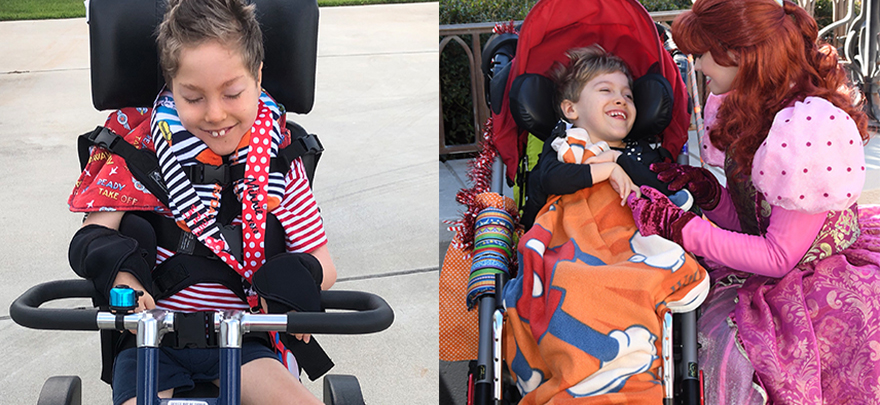
Joel age 9 & Leo age 7 are brothers both diagnosed with ZC4H2 Associated Rare Disorders (ZARD). Joel and Leo are often mistaken for twins and although they share many similarities, they have different personalities and preferences.
Joel and Leo love classic animated Disney movies and Walt Disney World. They love cruising on their adaptive bikes, riding roller coasters, exploring nature trails in their wheelchairs, swinging at the local park, feeling the ocean waves, listening to live jazz music in New Orleans, and spending time with extended family. Joel and Leo both attend school full time in a self-contained classroom for children with severe cognitive impairment. We live in middle Georgia, USA.
Joel loves tasting chocolate and sweets especially Georgia peach cobbler with ice cream. His favorite movies are currently Beauty and the Beast and The Little Mermaid which are watched daily. Joel has music playing 23 hours a day and will raise his elbow when he wants the song changed. He has been obsessed with music since infancy. Despite being nonverbal, Joel has strong opinions and loves making choices about his daily activities by smiling or raising his arm. He has an exceptionally precise internal clock and communicates when his schedule is off by minutes. Joel loves physical therapy and massage; however, he dislikes classwork and has mastered faking sleep to avoid it including snoring on occasion.
Leo, like many younger siblings, is influenced by his brother’s interests. Leo also loves Disney movies but prefers Moana and Aladdin currently. While Joel would prefer to relax in the pool, Leo prefers to splash and play with his dad. Leo loves riding in the golf cart with wind whipping through his hair. Although Leo is over fifty pounds (and bigger than his brother), he still loves to cuddle and expects cuddle time every night. Leo is a joyful child who is rarely without a smile. Also nonverbal, Leo has grown more opinionated about his preferences with maturity which we strongly encourage and will smile or raise a hand to make a choice.
Joel was diagnosed with the pathogenic ZC4H2 mutation through a lengthy and emotionally painful process. Joel’s health challenges were a surprise at birth. He had significant issues with breathing in addition to heart issues and as a result was air-flighted to Texas Children’s Hospital for heart surgery after a few days in the NICU. The genetic microarray panel completed at birth was incorrect and caused confusion in regards to treatment. Citing cost, insurance denied any further genetic testing. In part because of Joel’s contractures (Joel was never formerly diagnosed with arthrogryposis), Joel’s maternal grandmother ended up reaching out to Dr. Judith Hall via email and presented Joel’s case to her via slide show presentation. Dr. Hall suspected arthrogryposis and possible spinal muscular atrophy and directed us to the Translational Genomics Research Institute (TGen) which was conducting exome sequencing for a clinical study. We still failed to get a result until… Leo was born a year later. TGen compared Joel and Leo’s exome sequencing results and the diagnosis was finally made. However, in 2014, information about ZC4H2 was extremely limited and inaccurate. It was not until we connected with more families through Facebook that the diagnosis really made a difference in clinical treatment.
Unfortunately, Joel and Leo are severely affected by ZARD. Some of the neurological symptoms they have include: epilepsy, cortical visual impairment, apraxia, dysphasia, spasticity, muscle atrophy, cognitive impairment, tethered spinal cord, Riga-Fede disease (Joel), autonomic dysfunction, and neurological pain. They also have orthopedic symptoms which include: scoliosis, kyphosis, hip dislocation, rocker bottom feet (Joel), proximally placed toes, talipes equinovarus (Leo), ulnar deviation of fingers, proximally placed thumbs, and symphalangia (a lack of finger joint on the ring finger of their left hand). Other symptoms include: keratosis pilaris, bullous pemphigoid dermatitis, strabismus, ptosis (Joel), optic nerve hypoplasia (Joel), heart defect (Joel), urinary incontinence, and asthma. Joel and Leo both have spinal growing rods and gastric tubes. Joel and Leo both receive speech therapy, occupational therapy, physical therapy, and vision services in school, as well as additional physical therapy services in a private setting. As they have aged, we have prioritized their time in the classroom over additional private therapies.
Despite all of these symptoms, Joel and Leo live happy and enriched lives. Like many families we struggle with respiratory illness, surgery recovery, and general burnout, but we choose to focus on the positive by relying on our Catholic faith, supportive family, and caring medical professionals and educators.
I am so grateful to have found an amazing advocate, friend, and fellow special needs mother in Cathy Paul-Fijten. Thanks for creating this foundation and we look forward to continuing the mission of empowering our families with ZARD.
If any fellow parents have questions about our story feel free to reach me personally at connect@zc4h2foundation.org.